From a conversation with an LLM to a searchable research notebook, exploring the data, retrieval and open tools behind a useful answer.
Start with a real question
Imagine asking a large language model (LLM) to explain vortex shedding, summarise a paper or help interpret a solver log. These are inviting ways to bring AI into a research workflow. Now make the question more specific: Which boundary condition did we change between these two simulation runs, and where is that change documented?
An answer to that question depends on access to the actual case files and notes. A language model generates text from learned patterns and the context supplied to it; your local research folder does not automatically become part of that context. The Hugging Face LLM Course provides a foundation for understanding how these models work and how to use them.
That practical question opens up a larger topic: how to connect a model to information worth using. Documents, databases and retrieval tools all have a role in making the answer traceable.
Give the answer a source
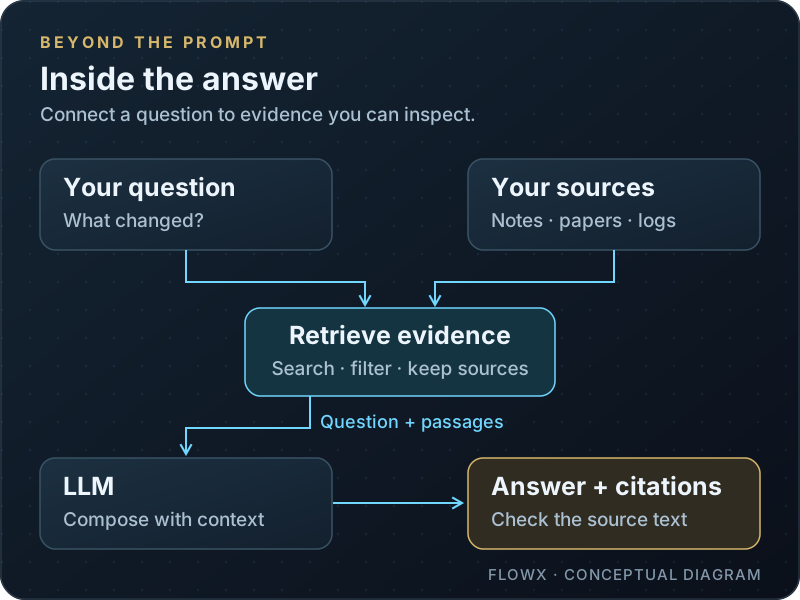
For a short document, you can supply the relevant text directly with a question. As a collection grows, selecting that text becomes a task of its own. Retrieval-augmented generation, usually shortened to RAG, adds a retrieval step: find relevant material, include it in the model’s context and ask for an answer grounded in that material. Hugging Face’s introductory RAG notebook illustrates this using a collection of GitHub issues.
A research-notebook version could follow this sequence:
- Prepare the sources. Extract readable text from notes and documents, divide it into useful passages and retain filenames, dates and page or section references.
- Retrieve the evidence. Search for passages relevant to a question, keeping their source references attached.
- Compose and check the answer. Give those passages to the LLM, request citations and check that the cited text supports the response.
Retrieval supplies context at answer time; updating the collection does not itself retrain the model. It also does not guarantee correctness. A useful evaluation checks both whether the right passage was retrieved and whether the answer represents it accurately. The advanced RAG guide explores choices such as document splitting and reranking retrieved results.
Where databases fit
Consider what the notebook needs to remember. A run identifier, Reynolds number or solver version belongs in a structured record. An explanation of why a boundary condition changed belongs in searchable text. Different questions call for different ways of finding that information.
| Question about a research collection | Useful retrieval method |
|---|---|
| Which runs used a particular solver version? | Filter structured fields in a relational database. |
| Where is a named boundary condition discussed? | Search the document text for relevant terms. |
| Which notes discuss a similar physical problem in different words? | Rank passages using embedding similarity. |
An embedding represents a piece of text as a numerical vector. A retrieval model maps questions and passages into a compatible vector space, where similarity can help rank potentially relevant passages. The Sentence Transformers semantic-search guide explains this process and why the embedding model must suit the task.
For a concrete implementation, PostgreSQL provides full-text search, while the pgvector extension adds vector storage and similarity search alongside ordinary database records. Its documentation also describes combining vector search with full-text search. This gives one possible home for case metadata, extracted passages and embeddings.
A small experiment can begin with files and an in-memory search index. A database becomes useful when you need persistent records, filters and repeatable updates. Preserve the original text and its provenance whichever storage approach you choose: a similarity score alone is not evidence for an answer.
Finding the pieces on Hugging Face
Once the workflow is clear, Hugging Face becomes easier to navigate. You may need a model to write the answer, an embedding model to retrieve passages and data to evaluate how well the system works. These components serve different purposes.
The Models Hub is a starting point for finding them. For a generator, consider language support, context length and the resources needed to run it. For an embedding model, consider the language and type of material being searched. Read the model card for intended uses, evaluation details and limitations, and record the model revision used in an experiment.
The Datasets Hub helps you discover shared collections for training and evaluation. A dataset is a collection of examples; the database in your application is the system that stores and queries your working information. A published dataset might help test a retriever, while your own notes supply the material it searches. Check the dataset card for its origin, contents and licence before adopting it.
Spaces adds a way to explore interactive demos, and Transformers provides model implementations for training and inference. Together, these resources support a progression from trying an idea to understanding and reproducing it.
When the prototype grows
Once retrieval and answer quality are useful, running the model becomes the next practical concern. The NVIDIA API Catalog offers an entry point for exploring hosted model APIs. NVIDIA NIM provides containers for self-hosting supported models as GPU-accelerated inference services, while TensorRT LLM provides tools for optimising inference on NVIDIA GPUs.
The choice depends on the workload. A notebook used occasionally and a service answering many simultaneous questions have different requirements. Measure response time and memory use with representative inputs, and check the selected model’s hardware and service requirements before choosing a deployment route.
Back to the research notebook
A manageable first project would use a small set of your own notes and a handful of questions whose answers you already know. Include exact lookups, questions that require connecting two sources and questions the collection cannot answer. Keep the retrieved passages beside each generated response so that mistakes are visible.
For CFD work, this could help recover the reasoning behind a case setup or locate the source of a modelling choice. Learning to predict the flow field is a further research direction: NVIDIA’s PhysicsNeMo examples provide an entry point into scientific machine learning for physical systems.
Begin with one question you repeatedly need to answer. Trace it from the original record through retrieval to the final response. That small exercise gives every tool in the workflow a concrete purpose.
Resources checked on 26 October 2026. The linked documentation is the reference for current APIs, hardware support and service availability.
